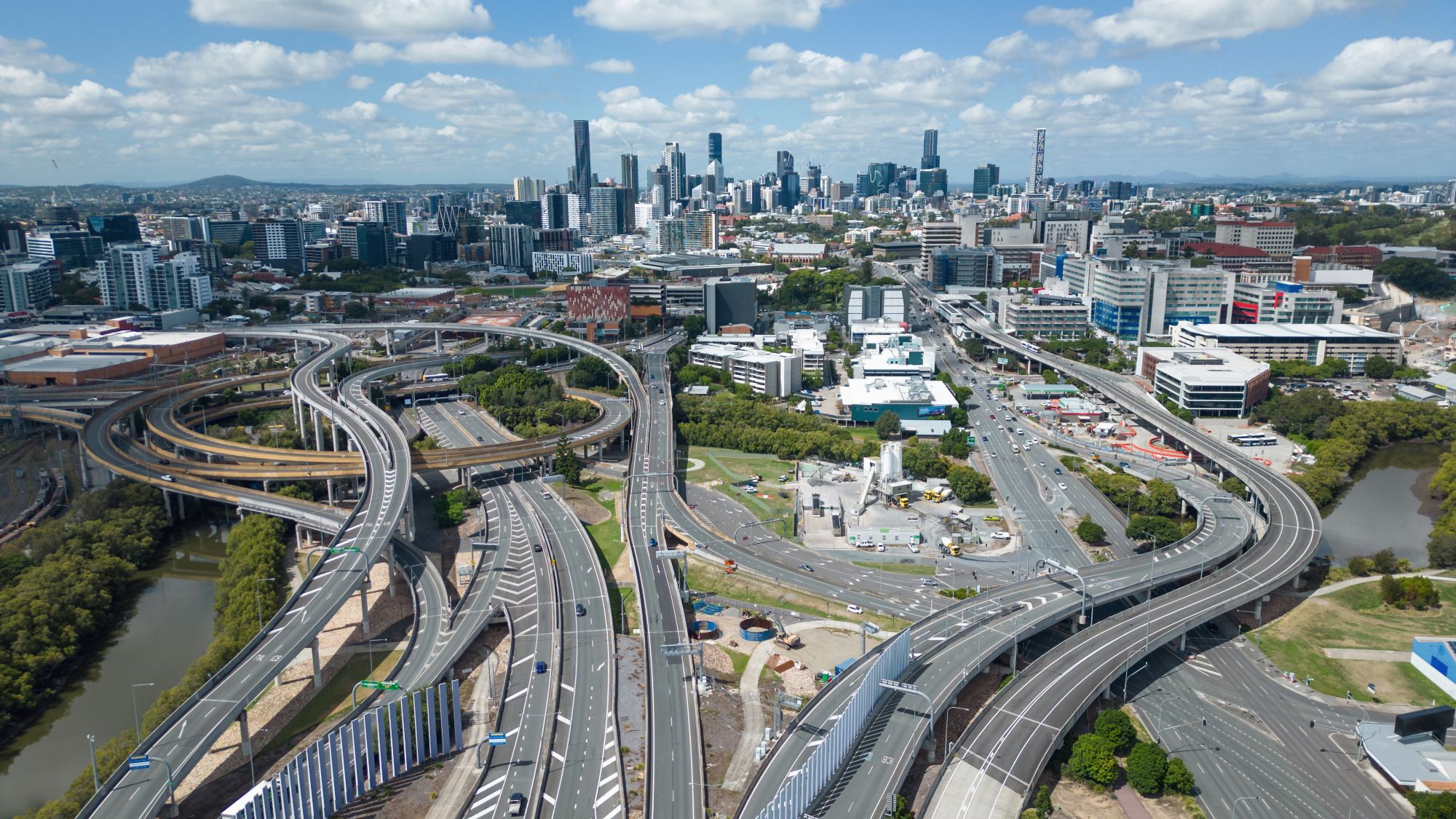
Queensland’s infrastructure, transport and construction industries are facing a monumental challenge. Pressure is mounting as the nation edges closer to hosting the 2032 Olympic and Paralympic Games, in Brisbane.
This marks only the third time that Australia has hosted the Games, with the 1956 Melbourne and 2000 Sydney games emerging as highly regarded events. Despite this history of success, unique and substantial challenges – some never faced on this scale – have presented barriers to the productivity and efficiency of delivery for the $120 billion building and infrastructure pipeline for the Brisbane games.
So, how can we actually identify where the problems lie?
WT’s report, From vision to legacy: a game plan for Brisbane 2032 and beyond provides a practical roadmap for delivering not only the 2032 Olympics, but also legacy infrastructure in a way that maximises value for southeast Queensland.
As Queensland State Lead Jack Shelley explains, this resource was developed not only to highlight ongoing issues, but also to identify the changes that could be made to greater support industry.
“There’s a lot of narrative out in the market around the challenges, but not really the levers that could be pulled and the ways to actually mitigate and manage these things moving forward. That’s what our report is focused on.”
The challenges
Just one of the key challenges is the sustained labour shortage, stemming from the COVID pandemic and enduring economic challenges being felt nationally and state-wide. WT’s analysis as part of the report forecasts a rolling three-year average construction labour shortage of 27,200 workers in 2026-27, 43,400 in 2027-28 and 46,000 in 2028-29.
One obvious aspect that’s placing even greater strain on the current workforce is the spread of demand.
“All of these different government entities have massive pipelines of work, so they’re all trying to vie for the same resource pool and same contracting pool,” Shelley says.
“Queensland’s market faces a fundamental step change in the availability of labour and plant. That means traditional delivery models that worked at a smaller capacity level aren’t enough for a program made up of hundreds of projects.”
Such demand, as well as other factors, are contributing to price and risk profile escalation, creating greater uncertainty for contractors.
The report points to the pipeline’s success depending on integrated planning across agencies, smarter bundling of work, and new ways of working – including digital tools and artificial intelligence – to keep costs, schedules and interfaces under tight control. This includes the potential of more dynamic, on-the-fly budgeting and programming rather than milestone-based schedules.
As Shelley explains, it doesn’t help that these issues are exasperated by the large volume of concurrent works that are taking place across the entire project program.
“When we’re speaking specifically about infrastructure projects, it’s not just one project, it’s not just one program, it’s hundreds of projects that are interdependently linked,” he says.
“The risk is that if one project fails, there’s a misalignment across the whole program, and therefore you end up with duplicated works, or you end up with clashing schedules or inconsistent procurement or mismanaged interfaces.”
These are similar to the challenges faced by developers in the recent London and Paris games, both of which offer key learnings that can be incorporated into the current Olympic infrastructure delivery.
More specifically, both London and Paris show the importance of early risk reduction, understanding the major risks on projects as soon as possible and putting mitigation strategies in place upfront, rather than reacting later when problems are already baked into design, contracts or schedules.
London and Paris are also held up as examples of strong integrated planning and coordination. Duplicated works, clashing schedules, inconsistent procurement, mismanaged interfaces and more were all prevented by tight planning, sequencing and governance.
The opportunities
Despite the findings, Shelley says it’s not all doom and gloom. He says the recent London and Paris games have demonstrated the biggest opportunity of all for Brisbane, to create a lasting infrastructure impact that will benefit the community for decades to come.
WT sees the next five to six years as an opportunity to “change gears” and establish a new normal for southeast Queensland – one built on resilient, well-planned infrastructure that can support a larger population, stronger health and education systems, and a more productive economy long after the games is over.
Beyond the infrastructure itself, Shelley adds that the state has a great opportunity to set the standard for the delivery of major scale infrastructure moving forward.
“The state’s approach, which could include productivity commission outcomes, risk models, bundling, and stance on delivery could set the blueprint for how Australia operates in that mega infrastructure space for the next while.”
“We’ve been around 76 years, and we’ve worked across most of the major projects. We know what it takes to deliver these projects, and we’ve got in-house expertise to be able to deliver the best quality outcome.”
A version of this article first appeared in Roads & Infrastructure Magazine April 2026 edition