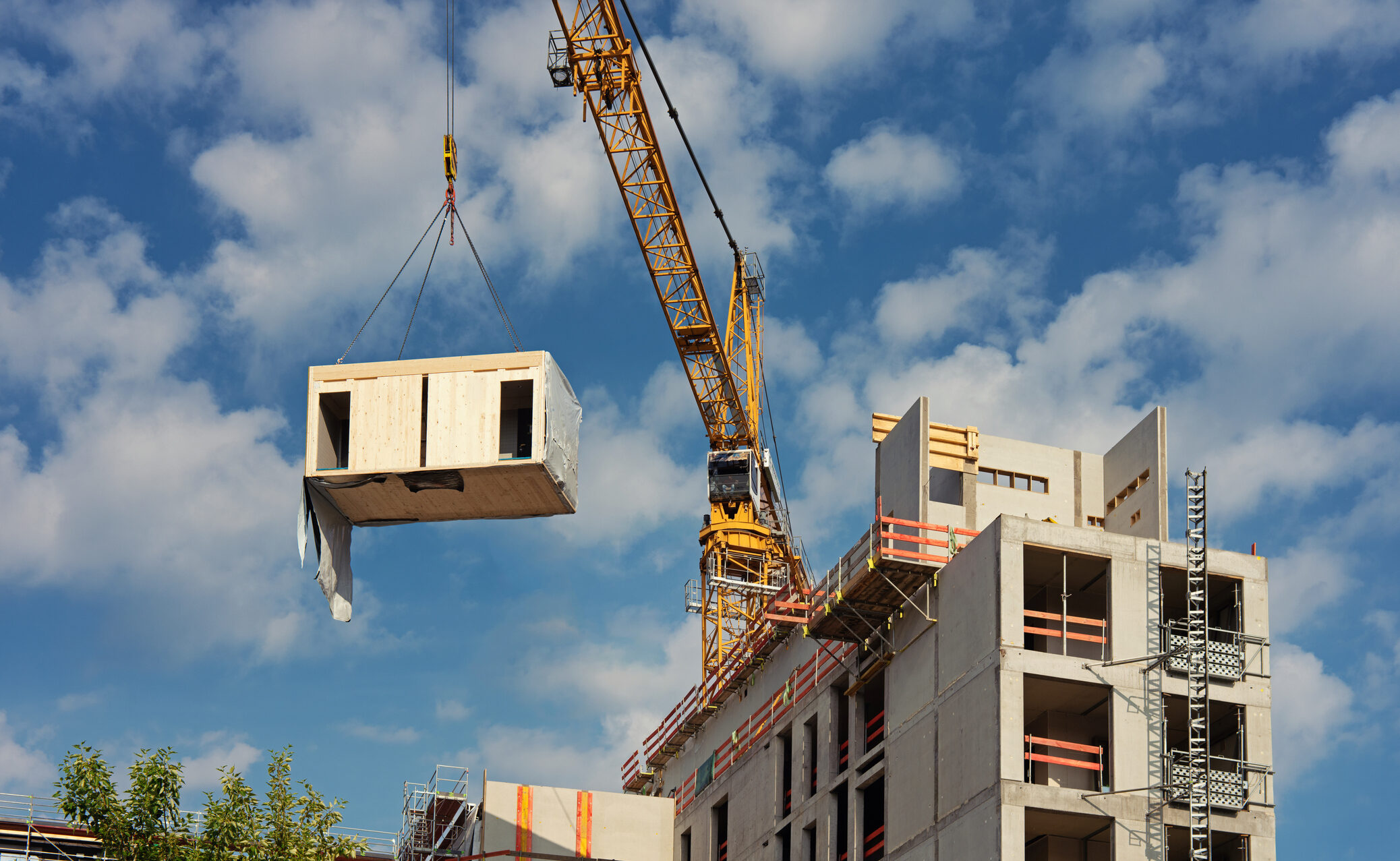
As Australia’s first large-scale modular living projects move into delivery, it’s becoming clear that success depends not only on construction technology, but also on choosing the right project and managing a fundamentally different commercial risk profile.
Modular offers a potential response to some of the pressures affecting housing delivery, including labour constraints, weather disruption, supply chain volatility and rising site preliminaries. Its clearest advantages today are speed, greater program predictability, and alleviating the demand on the current onsite construction labour supply. Consistent cost savings remain harder to demonstrate and will depend on scale, repetition and disciplined delivery.
While modular is often discussed as an alternative construction method, choosing it changes much more than how a building is assembled. It alters the project’s design process, procurement strategy, payment profile, supply chain and allocation of risk.
In many respects, modular is less a construction decision than a commercial decision.
Finding the right application
Modular is not a universal solution. Its value is strongest where there is sufficient repetition, suitable site access and a design that can be resolved early.
Purpose-built student accommodation, hotels and co-living developments can provide the consistent spatial logic that modular delivery needs. Repeated rooms, wet areas and service configurations create opportunities for standardisation and factory production. Foundations, services and other site works can progress concurrently, helping to shorten the construction program.
The calculation becomes more complex as layouts, module types and interfaces increase. Variation can interrupt factory efficiency and complicate coordination. At some point, the flexibility offered by conventional construction may outweigh modular’s potential program advantages.
Modular requires greater investment in early decision-making, with design resolved sooner, manufacturing capacity secured and factory-to-site interfaces clearly defined. Once production begins, changes that may be manageable in conventional construction can have much greater cost and program implications.
The tipping point will differ between projects and needs to be understood before deciding on the delivery model.
A different commercial risk profile
Traditional construction concentrates much activity, value and risk on the project site. Modular moves a significant proportion into a factory, possibly offshore.
While this production environment may be more controlled, it also introduces different commercial considerations. Developers and financiers may be funding materials and completed work before modules reach site. They will need confidence in manufacturing progress, quality, ownership, payment security, transport arrangements, insurance and the financial capacity of the parties involved.
These issues add weight to due diligence. A robust assessment needs to look beyond the headline construction price and program. It should consider the complete cost and risk profile, including manufacturing capability, logistics, compliance, currency exposure, payment arrangements, inspection processes and the allocation of responsibility between developer, manufacturer, builder and other project participants.
Risk also shifts as modules move from factory to transport and site. Contracts and controls need to establish when ownership transfers, how value is verified and who carries responsibility at each stage. These arrangements should be agreed early and updated through a live risk-allocation framework as the project develops.
For financiers, independent review can strengthen confidence that feasibility is complete, the program is realistic and risks due to off-site production are being actively managed. Working through these questions early can help developers avoid introducing commercial structures that later prove difficult to fund or insure.
From isolated projects to repeatable delivery
The advantages of modular depend heavily on the capability of the supply chain and continuity of demand.
Current Australian projects are creating practical knowledge around compliance, design coordination, manufacturing, transportation, installation, waterproofing, fire performance and connections between modules. These lessons will be valuable for future developments.
However, isolated projects are unlikely to create the scale to transform modular’s economics. Manufacturers need a sufficiently consistent pipeline to invest in facilities, automation, technology and skills. This would give contractors and subcontractors more market experience and confidence, removing the uncertainty and inexperience that can lead to pricing and program contingencies in tenders, which negate the efficiencies promised by modular construction.
This makes repeatable portfolios particularly relevant. Institutional owners developing student accommodation, hotels, co-living, social and affordable housing or other standardised living assets may be able to build the continuity that modular manufacturing needs.
Better information connects factory and site
When design, manufacturing and construction occur across different organisations and locations, information management becomes even more critical. Clear BIM requirements and coordinated digital models allow teams to work from consistent information and identify interface issues earlier. They also streamline manufacturing and quality assurance.
Structured asset information keeps delivering benefits through handover, maintenance planning and longer term operations, provided operational requirements are considered early and data integrity is maintained throughout delivery.
Digital capability won’t remove modular risk, but it will make risk more visible and manageable across design, procurement, manufacture, installation and operation.
Applying modular where it makes sense
Modular is already contributing to rolling out accommodation to address Australia’s housing challenge, and the scale of its contribution is sure to grow.
The recipe is applying it selectively, where repetition, project scale, site conditions, design discipline and supply chain capability suit. Achieving full value will also require developers, investors and lenders to recognise that a modular project can’t be financed, procured and governed in the same way as a conventional construction project.
The projects being delivered now are providing practical evidence the market has been waiting for. The next step is to turn these lessons into delivery models that are bankable, repeatable and resilient.
Modular can clearly work. The question now is whether the project, commercial structure and supply chain are aligned to make it all stack up.