Australia’s renewable energy numbers tell two very different stories.
In 2025, renewables supplied 42.7 per cent of Australia’s electricity, up from 39 per cent the year before. Yet only 2.3 GW of new large-scale renewable generation reached financial close, down from 4.4 GW in 2024 and one of the lowest levels in a decade.
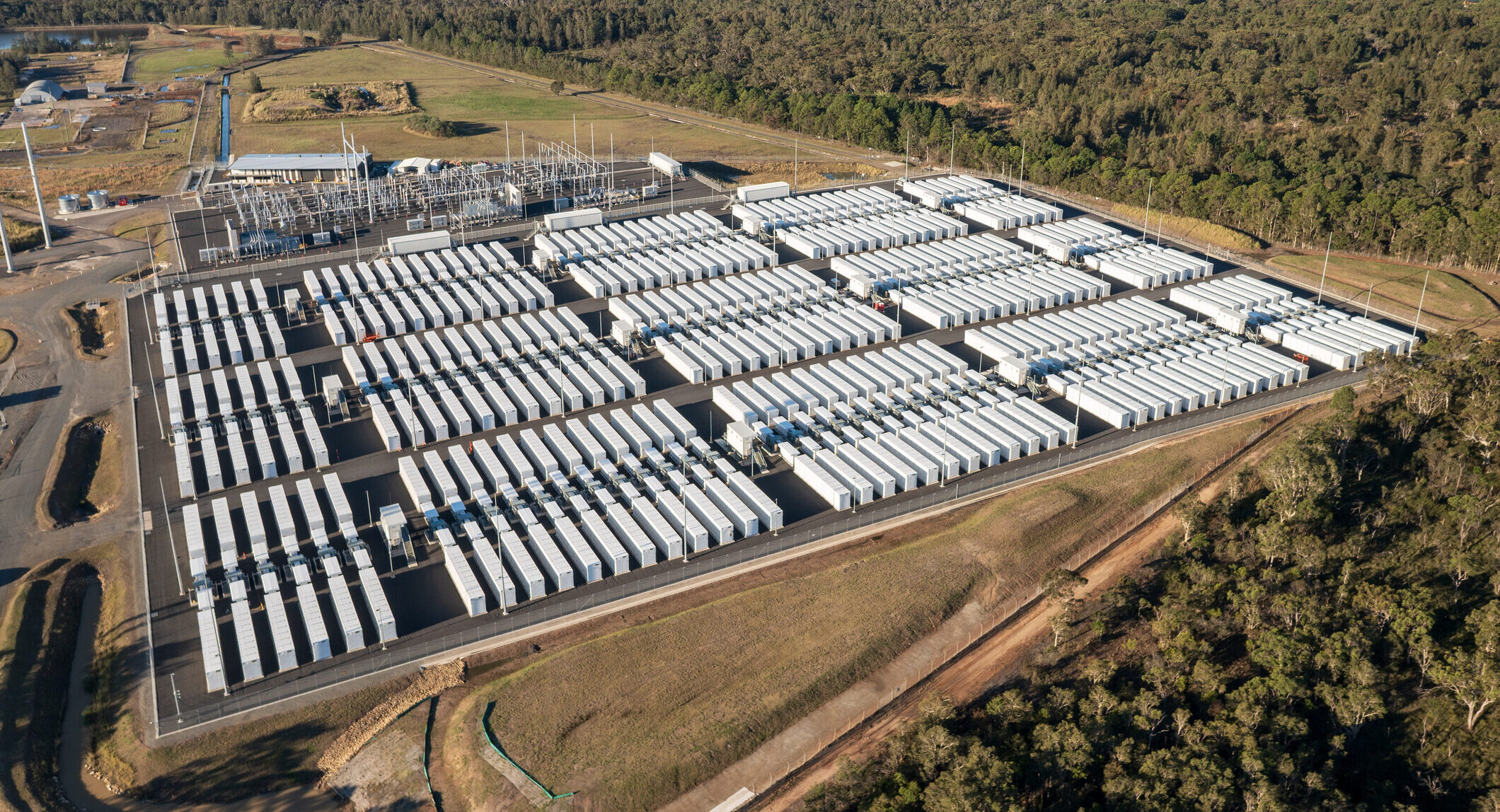
For large-scale batteries, however, a record 4.3 GW of new capacity reached financial commitment. Australia is now the world’s third-largest utility-scale battery market.
I think something interesting is going on here, and that this divergence tells a story that is less about cost than about how the market prices risk.
The pipeline prefers certainty
Batteries have had the benefit of falling technology costs, but they also move faster through the delivery system than other renewable projects. AEMO puts batteries at 53 per cent of the current connections pipeline, ahead of hybrid solar-plus-battery at 18 per cent and onshore wind at 15 per cent.
Some of the pressure on wind pricing is driven by genuine construction costs, including labour, plant, materials and specialist supply chains. However, these increases in underlying cost don’t account fully for increased overall price. Part of the number is the market’s response to uncertainty (like planning, access, grid and community constraints).
When a bidder isn’t confident about scope, program, ground conditions or interface responsibilities, they have three choices: qualify the risk, exclude it, or price it. Some bidders will back themselves that the risk won’t eventuate, and others will protect themselves with contingency. Five capable bidders could read the same documents and arrive at materially different prices.
The spread is more telling than the average
Tender analysis tends to gravitate towards the average price, or the gap between the preferred bidder and the budget. The spread of bids is usually more revealing.
A narrow spread suggests bidders have read the scope, quantities and risk position broadly the same way. A wide spread suggests they haven’t, with different assumptions about productivity, temporary works, ground conditions, connections, escalation, interfaces or program exposure.
If five bidders price the same scope 20 to 30 per cent apart, the question is whether they have really priced the same project. Tender returns provide evidence of scope definition and risk understanding, not just market price.
Three boreholes don’t create certainty
Ground conditions show the difference between identifying and quantifying a risk.
A contractor might be asked to price a large renewable site supported by data from three boreholes. The question then becomes less about dollars and more about evidence. How representative is the coverage, what quantities could be affected, and how does the allowance compare with known geology and similar projects?
Where the evidence is thin, the honest answer may be a risk range rather than a single figure, giving the client, contractor and investor a more credible basis for deciding how to manage it.
Quantify before you allocate
Contracts can transfer responsibility, but they can’t transfer knowledge that doesn’t exist.
Allocating a poorly understood risk to a contractor often brings contingency, exclusions and qualifications. Effective risk allocation starts with quantification.
Fair allocation places responsibility with the party best able to understand, influence and manage it, supported by a clear definition of the risk and what it might cost. Where neither party can quantify an uncertainty, collaborative mechanisms, further investigation or a defined adjustment process will usually beat forcing bidders to price an unknown.
A GMP is only as good as its basis
Does the answer to cost uncertainty lie in open-book procurement and guaranteed maximum price (GMP) arrangements? These can work well, but a GMP isn’t inherently a fair price. It is a commercial ceiling built on a defined scope, a set of assumptions and an agreed treatment of risk.
Assessing a GMP properly starts with the fundamentals: quantities, rates and subcontractor coverage, tested against a project-specific independent estimate rather than generic market benchmarks. Productivity, preliminaries and escalation come next, and each carries an assumption about how the project will actually be delivered, which is where most of the variance between a fair price and an optimistic one tends to sit.
Exclusions, program logic and contingency are the most consistently underestimated, because they describe what the price doesn’t cover and what happens when the program moves. Design maturity sits underneath all of it: the less resolved the design, the harder the reviewer has to work to separate quantified cost from provision for uncertainty. In practice, reviewers aren’t always given everything they’d need to do that properly, and certification shouldn’t imply more certainty than the evidence supports.
Four lessons major infrastructure has already learned
Renewable energy construction can look to the transport, water, utilities and social infrastructure sectors, where investment decisions and financial close have long depended on good evidence.
Lesson one: separate the base cost from the risk allowance, so owners can see what the defined scope should cost and what is being carried because an outcome is still uncertain. Two: connect the estimate, the program and the risk register, because a cost allowance without a program consequence is incomplete and a program risk without a cost impact is misleading. Three: keep a traceable basis of estimate, updated as the project develops. And four: use independent challenge to test whether the contingency reflects quantified exposure.
Making risk visible
There is no shortage of activity in the market. A record 9.1 GW of new generation and storage reached full output in FY26, more than twice the previous year, and data centre demand, electrification and industrial decarbonisation are all pushing the system to deliver faster.
The constraint is certainty. Projects move more efficiently when assumptions are tested early, risks are quantified before they are allocated, and pricing rests on evidence rather than broad allowances. Investors, lenders, owners and contractors all want a clear view of what is known, what isn’t, and who is best placed to manage the difference.
A certain level of risk is inevitable, but it must be made visible. When uncertainty is better understood, contingency becomes more proportionate, tender returns become easier to interpret, and investment decisions become far easier to defend.
Data sources: Clean Energy Council, Clean Energy Australia 2026 (May 2026) and Quarterly Investment Report: Large-scale renewable generation and storage, Q4 2025 (February 2026); AEMO, NEM Connections Scorecard FY26 (June 2026).