Australia needs more purpose-built student accommodation (PBSA), but development continues to lag behind demand.
Land near city universities is scarce, construction costs remain elevated and rents cannot absorb every increase in development and operating costs. New entrants need to understand the asset class quickly, while established operators must be selective about where they deploy capital.
In a high-volume operating business, seemingly small decisions can have a significant cumulative impact. The challenge is to understand how each choice will affect cost, resident experience and asset performance over time.
Start with the investment case
PBSA is a scale-driven business, and scale amplifies both strengths and weaknesses. A change to bathroom specifications, finishes, services or room layouts may have a modest impact on the initial cost, but a much larger effect when multiplied across an entire building and its operating life. The feasibility process should therefore test how each design and development decision affects the income and cost profile of the asset.
Established operators have the advantage, with evidence about which amenities students value and where maintenance costs bite. New entrants should seek industry benchmarking to build this understanding.
Consider adaptive reuse
Land availability and cost, particularly close to major universities, is among the sector’s hardest constraints. Adaptive reuse of older commercial buildings may offer a well-located alternative to a new build, and PBSA suits some conversions well: compact rooms, communal amenity and single-management operation can often work well within commercial building geometry.
The apparent cost advantage needs careful testing. Change of use can trigger contemporary fire, egress, accessibility and acoustic requirements. Existing services may be inadequate for residential hot water and ventilation loads. Façade condition and thermal performance may require substantial intervention. These issues need quantifying during due diligence through reality-capture methods and intrusive investigations, because the margin between an attractive conversion and an unviable one is often narrower than an initial yield comparison suggests.
Design for operation
Students want more than a room and a desk, but every additional feature comes at a price. The discipline lies in identifying where variation adds value and where it simply adds cost and complexity. Repeating room types, bathrooms, services arrangements and finishes can simplify procurement, construction, maintenance and refurbishment.
The same applies to shared spaces. They can be an important part of the student experience, but they also consume valuable floor area. Their contribution to occupancy and rental income needs to be understood alongside their initial cost to build and ongoing cost to clean, manage and maintain.
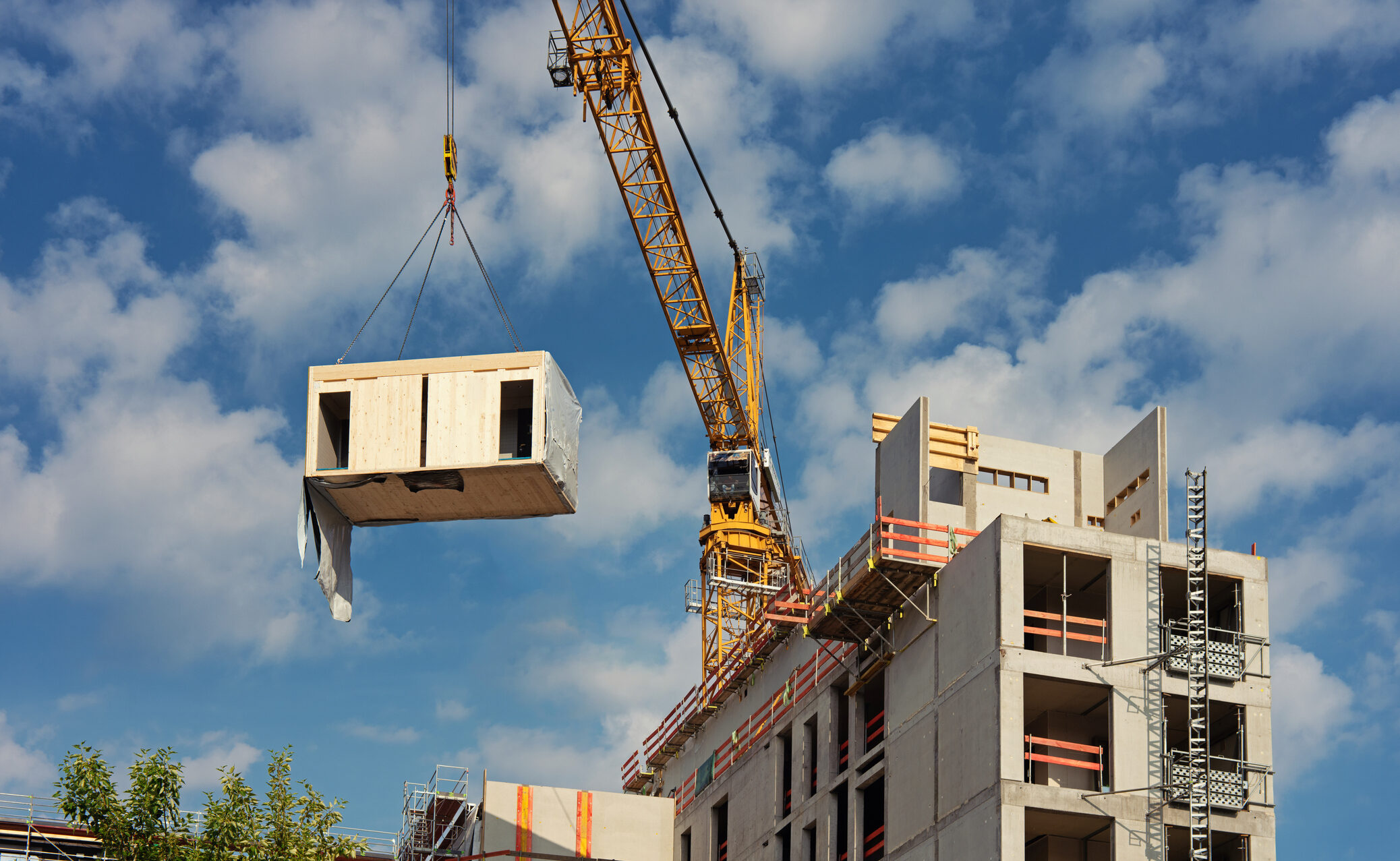
Modular construction is gaining momentum in PBSA for precisely this reason. The sector has the repetition that makes off-site production viable. It works best where layouts, structural grids, services and façade systems are designed for repetition from the outset. Late changes and bespoke elements erode the benefit. Whether it delivers a better outcome depends on weighing cost, quality, speed to market, manufacturer capacity and supply chain risk together, project by project.
Look beyond construction cost
A PBSA building can operate for decades, and high occupancy and frequent room turnover place considerable demands on finishes, services and common areas. Durability therefore deserves extra attention. Floor and wall finishes, joinery, door hardware, bathroom fittings and appliances should be selected for robustness and ease of replacement.
Standardisation can make a difference here. A limited palette of components simplifies spares holding, shortens repair times and makes maintenance more predictable.
Paying more upfront can make sense if it reduces operating or replacement costs over time. Whole-of-life cost analysis can test those trade-offs rather than assuming that the lowest capital cost represents the best value.
Make digital information useful
Digital tools can support these decisions, but their value depends on how they are used. BIM can improve design coordination and support cost and procurement decisions during development. For adaptive reuse, reality capture can establish accurate information about an existing building. Once the asset is operating, the BIM model can continue to support maintenance, compliance, energy monitoring and future refurbishment.
That only holds if models are set up properly and maintained throughout the lifecycle by experienced, independent data specialists. Without clear information requirements and governance, models can lose critical information as they pass from design to construction and finally to operation, leaving the operator with a model that no longer accurately reflects the asset and is less useful for predicting future performance and planning maintenance and replacements.
Building for long-term performance
Competitive advantage in PBSA will increasingly come from how well projects are structured rather than from adding more beds. A university partnership may improve the land equation on one site. Adaptive reuse may make a difficult location viable on another. Modular construction may accelerate delivery on a highly repetitive scheme, while a conventional approach may carry less risk elsewhere. The opportunity lies in choosing the right combination for the particular asset and making those decisions early enough to influence the outcome.
The commercial sweet spot is where capex, opex and yield work together. Finding it means understanding PBSA for what it is: a high-volume operating business in which small decisions repeat hundreds of times and keep affecting performance long after practical completion.